
This week Koji Matsunobu and I will be sharing some preliminary work on vocaloids as a medium for music learning at the Asian Pacific Symposium for Music Education Research in Malaysia. Here are a few resources for those interested to know more.
Here is a copy of our working paper, “Singing with Hatsune Miku: Vocaloids as a Medium for Music Learning.” [EdUHK Online Repository link]
These are our presentation slides, with the usual caveat that they’re not a stand-alone medium and are probably most helpful for those who saw the talk: Vocalo presentation slides PDF.
Here’s a brief sample of vocaloid work focused on Miku:
Our primary argument is that Miku can best be approached by educators as a medium for musical expression, development, and learning. Here, we follow those in sound studies who characterize a medium as a contingent network of people, practices, institutions and technologies. The recurring patterns also have implications for pedagogy as wants, needs, values, and practices change and are changed by enmeshment with the medium. Take, for example, how the ability to sing at very fast tempi has been taken up by utaite, singers who focus on emulating their idols (in this case, Miku):
Finally, if you would like to spend more time watching Miku videos, this is a personal playlist of videos that are either musically expressive or of other interest:
 Mong Kok, which means “crowded corner” earns its name as one of the most densely populated areas in the world, with 350,000 people per square mile. Each Saturday night and all day on Sunday, Sai Yeung Choi street is closed to cars and turned over to pedestrians. The heart of the action is karaoke, but there are also fortune tellers, artists, jugglers, political protestors, street food vendors, and so on.
 The scene is acoustically chaotic—one can typically hear two or three groups at once, and sometimes a particular group’s PA can be heard for a whole block—at one point I heard “Smoke on the Water” and Cantonese opera from adjoining groups. And there is a constant flow of pedestrians squeezing past. In all there are several dozen groups set up. Tipping is accepted, but it seems ancillary to the overall experience, which is to come out and make music together. Many in the audience will sing or dance along with songs that they know, while others sit on a small number of plastic seats. Some bring a picnic dinner, and you can see one photo below of a DJ who brought his small dog.





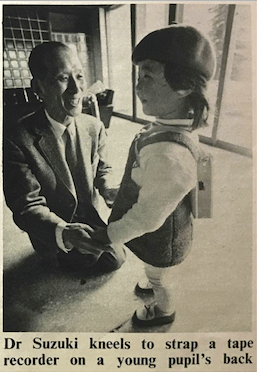 This historical study examines the mediated pedagogic techniques of the Suzuki Method. I explore the role of mothers as pedagogic and technological innovators, the development of approaches to learning through listening, Suzuki’s notion of a recording as teacher, and the pedagogic extension of the method through the adoption of the compact cassette tape format. Finally, the resonance between the Method and Japanese educational ideas is contrasted with the American resistance to recordings.
 Matthew Thibeault