Visualizing Compression in the MP3 format

I’m just starting the work and fun of reading/writing/thinking/rereading/rethinking/rewriting my way through Jonathan Sterne‘s wonderful new book, MP3: The Meaning of a Format (introduction here) For those unfamiliar with his work, here’s a representative quote from the beginning:

Because it uses both kinds of compression [redundant data compression and perceptual coding], the MP3 carries within it practical and philosophical understandings of what it means to communicate, what it means to listen or speak, how the mind’s ear works, and what it means to make music. Encoded in every MP3 are whole worlds of possible and impossible sound. (p. 2)

When I explore lossy and lossless formats with my students, I often use a visualization of MP3 files, which allows us to learn from looking at representations of sound (one of my interests). It is clear how the bit rate lops off the upper frequencies drastically, with 56kbps very audibly different even with laptop speakers (of course, Sterne’s book takes this much more seriously and challenges the notion that compression is a bad thing, but this visualization presents some of the ideas that can be explored). In honor of the conversations that will be stimulated by Sterne’s book, here’s the PDF file with embedded audio. [Note: since YouTube and many sharing sites compress uploaded video and audio, I’ve released this as a PDF that has embedded audio, which is best heard using Adobe Reader. This way, I’m confident that when you click each format, you’re hearing that format and not a re-compressed version.]

Posted in Uncategorized | Tagged , , | Leave a comment

Summer fun (Bruno Nettl visit)

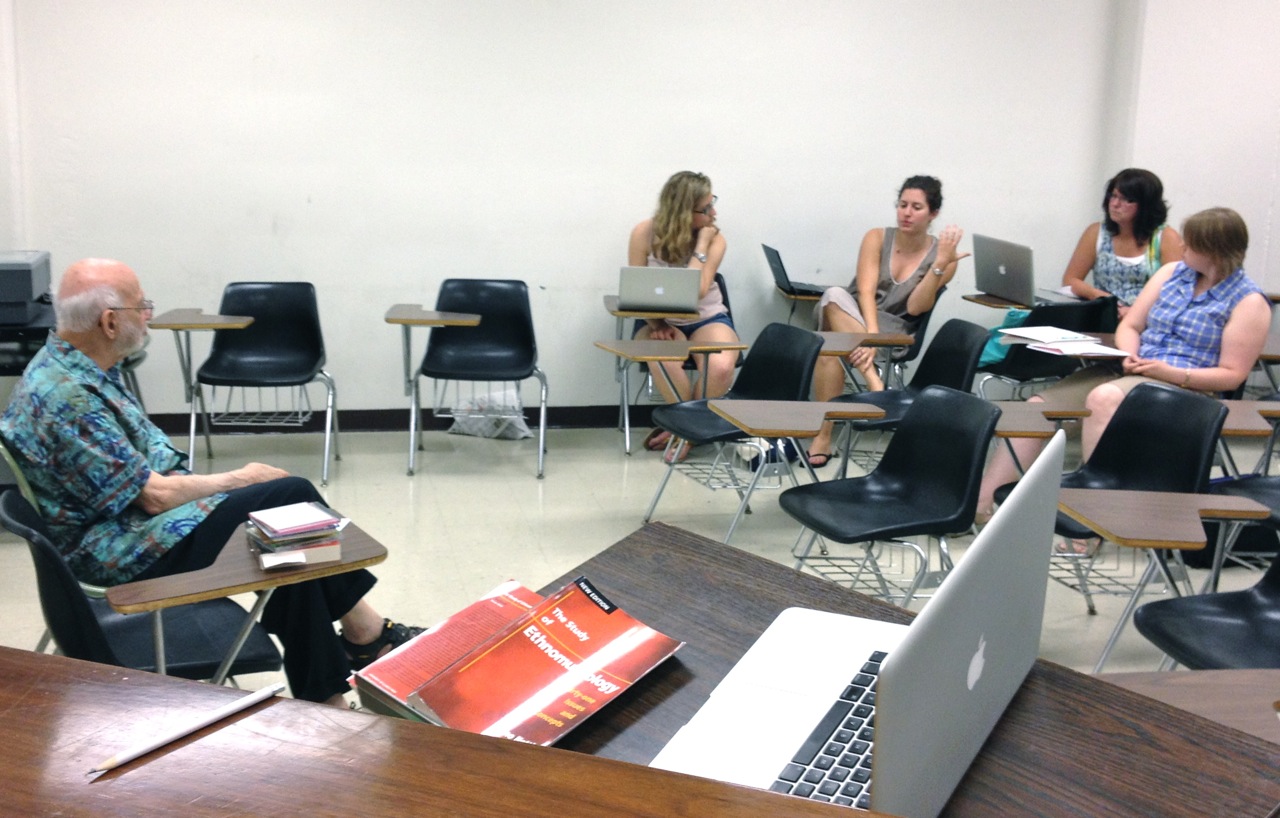
One of the great joys of summer teaching is having guest speakers. Last week we welcomed my colleague, the eminent ethnomusicologist Bruno Nettl. We discussed the chapter “How Do You Get to Carnegie Hall? Teaching and Learning” from his wonderful The Study of Ethnomusicology.

Although the book is a treasure, there’s nothing like enjoying Bruno’s humor, insights, stories and musical examples in person. As the chapter states, “A comprehensive understanding of the music of a culture includes the way it is learned and the materials that are used to teach it” (p. 389). He said, if anything, he would expand the chapter as the importance of teaching and learning are increasingly central to ethnomusicology.

Posted in Uncategorized | Tagged | Leave a comment

Ubiquitous Music Learning in a Postperformance World [NSSE Yearbook chapter]

I have a chapter in the just released book, The place of music in the 21st Century: A global perspective. The one hundred-eleventh NSSE yearbook. My chapter, “Ubiquitous Music Learning in a Postperoformance World” looks how peopled changed and were changed by two technological innovations: sound recording in the late 19th century, and digital media in the late 20th century. I try to provide some avenues by which the music education profession can critically engage with the profound changes in music, musician, and audience.

Google has a copy of my chapter available here.

Congrats to Cathy Benedict and Patrick Schmidt for pulling all this together, and I hope the volume promotes some rich discussion.

Posted in Uncategorized | Tagged , , , | Leave a comment

Play an instrument? Sing? Play these games!

Tomorrow (June 12, 2012) I’ll be presenting at the Games, Learning, Society 8.0 conference, along with Nick Jaworski and Ben Smith.

We will be presenting in the Beefeaters hall at 3:30 p.m.

The topic of our presentation is a suite of games we’ve developed where you play the game by singing or playing an instrument. We believe this to be unusual in the arena of game based learning. Screenshot of the balloon game on the right.

Download the games here (Mac version, others hopefully coming soon).

Read the paper, “Developing games that can create real heroes on real guitars: using acoustic musical instruments and the human voice as controllers” here. The games are free, and can utilize built-in or external microphones. [Update: the paper has been published in the conference proceedings, which I’ve linked to in this post.]

Many thanks to the rest of the team members (Guy Garnett, Nick Jaworski, Catherine Schmidt-Jones, Ben Smith) and also to the University of Illinois, which funded this project through a Creative Research Award.

Posted in Uncategorized | Tagged , , , , | 3 Comments

New secondary general music education book

Engaging Musical Practices, edited by Suzanne L. Burton, has a wealth of great ideas for secondary general music. I particularly appreciate the blend of practical ideas, research, and theoretical issues brought out by the authors.

I wrote an endorsement for this book last fall, and just received a physical copy. The final product looks great, and both the topics and authors are top-notch. Rather than rehash the contents you should check it out yourself.

Posted in Uncategorized | Leave a comment

The Illinois Program for Research in the Humanities

It is an honor and a pleasure to share the news that I will be a Faculty Fellow of the Illinois Program for Research in the Humanities (IPRH) for the 2012-2013 school year, joining six faculty members and a group of graduate students.

I will continue working on a book project related to the twin revolutions of sound recording and digital media from a pragmatic philosophical position. It is a delight to look forward to the sharing my work in the yearlong Fellows Seminar, receiving an extra research funds allocation, and enjoying a teaching release for spring 2013.

More here: http://www.iprh.illinois.edu/news/#article61808

Posted in Uncategorized | Tagged , , , | Leave a comment

The Politics of Journal Publishing (music education edition)

I’ve been sharing with friends and colleagues a wonderful article from cultural studies by Ted Striphas, “Acknowledged Goods: Cultural Studies and the Politics of Academic Journal Publishing.” I’ve gotten enough feedback, including a great discussion in our doctoral seminar at Illinois, that I thought I’d mention it here (if you’re within an institution that subscribes to T&F journals, you might have access here, otherwise, there’s a free version here). And a tip of the hat to Super Bon!, where I learned of the Striphas piece.

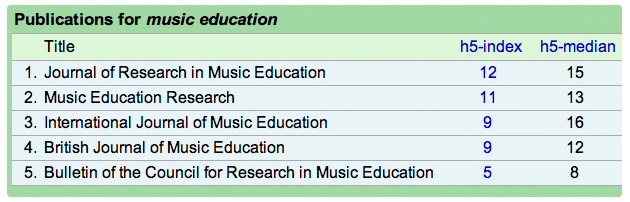
I wanted to see if some of the points he made held true for music education. Google scholar now creates journal ranks, and here are the top five for music education (retrieved early April, and which are not surprising):

Now, let’s look at some of the points Striphas makes about journals in cultural studies and see if they hold true for these journals. This isn’t a complete examination, but enough to get the conversation started.

A Rising Oligopoly
Striphas claims that we’re on our way to an oligopoly, with a just few publishers holding most of the power despite more journals overall. Continue reading

Posted in Uncategorized | Tagged , , , , | 6 Comments

Media and Music Education (NAfME Philosophy SRIG)

A presentation I gave at the NAfME Philosophy SRIG ended up as a column for General Music Today, which you can see here:

https://journals.sagepub.com/doi/abs/10.1177/1048371314522646

Posted in Uncategorized | Tagged , , , , , , , , , | 1 Comment

Piece on Creative Rights [in Music Education Research]

ImageMusic Education Research has just published an article of mine on creative rights, “From compliance to creative rights in music education: rethinking intellectual property in the age of new media.” [Free open access post-print version available, or view on the MER site behind a paywall.]

In the article, I discuss changes in creativity, content, and culture and how they change the ecology of copyright. The compliance approach to copyright is critiqued, and I present an alternative approach that builds from a the creative rights of the student.

As my students know, the article represents the culmination of many years of work (and see my 2010 CITES lecture and Idea Bank piece from Music Educators Journal for related content).

Posted in Uncategorized | Tagged , , , , | 5 Comments

Speaking at the Center for the Study of Education and the Musical Experience

I recently visited Northwestern University, where I shared a paper with the famed doctoral seminar at CSEME. The paper, “Ubiquitous music learning in a postperformance word” is my contribution to The place of music in the 21st century: The one hundred-eleventh 2012 NSSE yearbook (forthcoming).

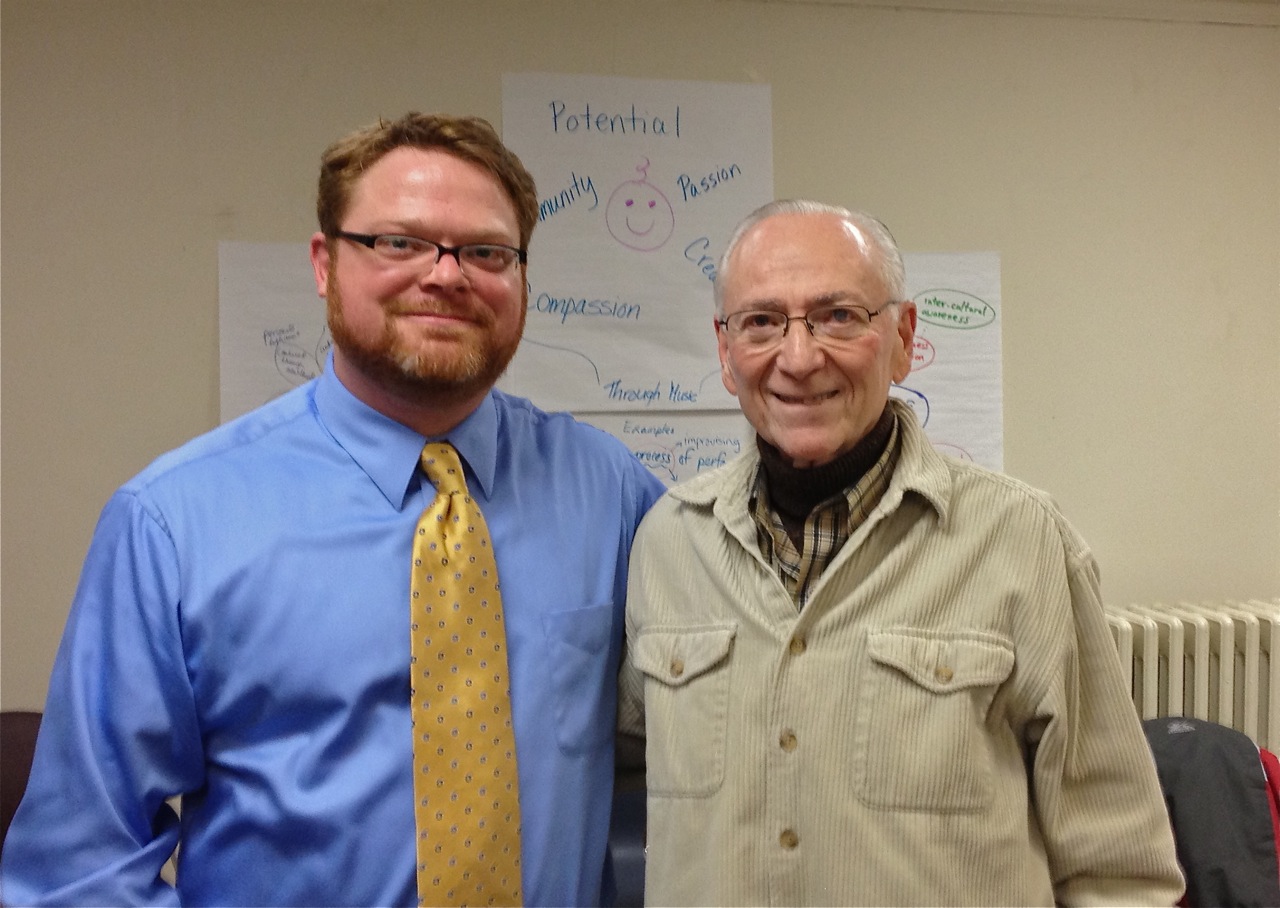
It was truly a pleasure to meet everyone, discuss my work, and interact with the CSEME seminar. Of course, it was also a special honor to share and discuss my ideas with Bennett Reimer. Special enough for a photo:

Posted in Uncategorized | Tagged , , | Leave a comment